


About
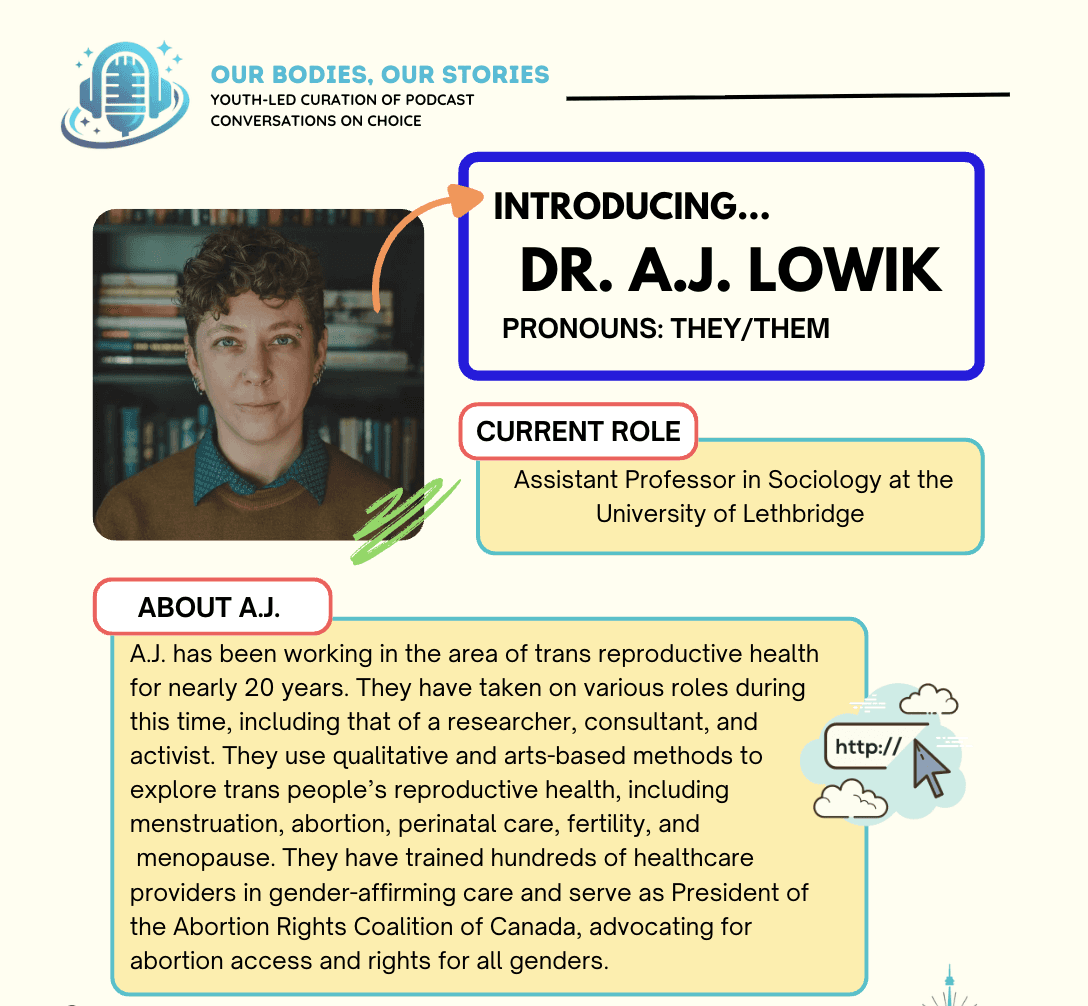
In this episode, we speak with A.J. Lowik, an Assistant Professor in the Sociology department at the University of Lethbridge. With nearly 20 years of experience in trans reproductive health as a researcher, consultant, and activist, A.J. discusses the experiences of transgender individuals when accessing abortion services. They address the challenges and gaps in care, as well as ways to enhance affirmative care and protect trans people in Canada moving forward.
Short bio: A.J Lowik is an Assistant Professor in the Sociology department at the University of Lethbridge. They are a researcher, instructor, consultant, and the president of the Abortion Rights Coalition of Canada. They are dedicated to trans folks' health and wellness which includes their reproductive and sexual lives.
Reproductive Justice
the right to control your sexuality, gender, work and reproduction, including the right to have children, to not have children, and to raise children in safe and healthy environments. Reproductive Justice was coined by the Women of African Descent for Reproductive Justice in 1994. To learn more, please visit https://www.sistersong.net/reproductive-justice
Sex
refers to an individual’s gender assigned at birth and is typically categorized as male or female (American Psychological Association, 2015)
Gender
Gender identity and gender expression are related, but they are not the same. Gender identity is a person’s internal sense of their own gender. Gender expression is how a person presents and expresses their gender. This can include their clothing, hairstyle, behaviour, and other outward characteristics. https://egale.ca/awareness/egale-explains-gender-identity/
Intersectionality
Intersectionality is a framework that describes how our overlapping social identities relate to social structures of racism and oppression. Intersectionality merges many identity markers, including race, class, gender, sexual orientation, age, ethnicity, religion, disability, and more, to create a more truthful and complex identity. The term was coined by Kimberle Crenshaw in 1989 in the article “Demarginalizing the Intersection of Race and Sex: A Black Feminist Critique of Antidiscrimination Doctrine, Feminist Theory and Antiracist Politics”.
Reproductive Rights
Reproductive rights are about the legal right to contraception, abortion, fertility treatment, reproductive health, and access to information about one's body as it relates to reproduction. (Bernstein, 2023) https://www.webmd.com/sex/what-are-reproductive-rights
Self- Managed Abortion
refers to actions people take to end a pregnancy outside the formal health care system (American College of Obstetricians and Gynecologists, 2024)
Crisis Pregnancy Centers
clinics or mobile vans that look like real health centers, but they're run by anti-abortion activists who have a shady, harmful agenda: to scare, shame, or pressure you out of getting an abortion, and to tell lies about abortion, birth control, and sexual health. (Planned Parenthood Federation of America, n.d.)
Belief-Based Care Denial
when a healthcare provider denies someone a treatment or service on the basis of their personal or religious beliefs. “Conscientious objection” is another term that has been used to describe this. To learn more about belief base care denial, check out this paper written by the Abortion Rights Coalition of Canada https://www.arcc-cdac.ca/media/regulation-belief-based-denial-of-care.pdf
Patient Centered Care
Integrated health care services delivered in a setting and manner that is responsive to individuals and their goals, values and preferences, in a system that supports good provider–patient communication and empowers individuals receiving care and providers to make effective care plans together. (Centers for Medicare & Medicaid Services, n.d. https://www.cms.gov/priorities/innovation/key-concepts/person-centered-care
Affirming Care
Gender-affirmative health care can include any single or combination of a number of social, psychological, behavioural or medical (including hormonal treatment or surgery) interventions designed to support and affirm an individual’s gender identity. (World Health Organization, n.d.) https://www.who.int/standards/classifications/frequently-asked-questions/gender-incongruence-and-transgender-health-in-the-icd#:~:text=What%20is%20gender%2Daffirmative%20health,affirm%20an%20individual's%20gender%20identity
Gender-Affirming Care
refers to a patient-centered approach to healthcare delivery that affirms someone's gender (i.e., using affirming and correct language for someone)
Stigma
a set of negative beliefs and assumptions aimed at making people ashamed for engaging in certain practices. Often used as a form of social control, abortion stigma prevents people from safely accessing life-saving information and resources.

