


About
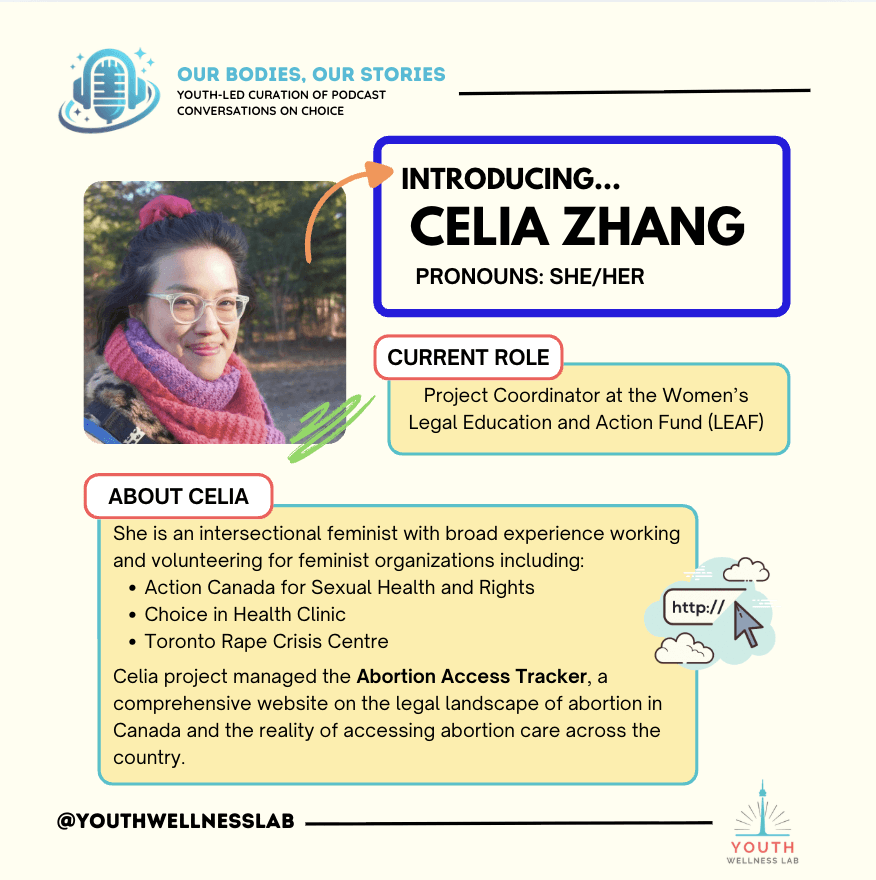
In this episode, we interview Celia Zhang, Project Coordinator at the Women’s Legal Education and Action Fund, who joins us to discuss the legal landscape of abortion in Canada. They discuss how abortion is treated as healthcare through the Canada Health Act and emphasize the crucial role of advocacy in maintaining the high level of abortion protections we currently have, especially in light of historical (and current) legislative attacks.
Please note that this episode contains mentions of rape and incest – audience members are encouraged to listen with care.
This episode was recorded in September 2024, prior to the official government announcement of the April 28, 2025 federal election. As a result, any mention of a “potential election” is in reference to this. Moreover, this episode is intended for educational purposes only and therefore cannot replace the advice and services of a legal professional.
Accessibility
Refers to the level that someone is able to use or access a specific environment, object, or service.
Belief Based Care Denial
refers to when a healthcare provider denies someone a treatment or service on the basis of their personal or religious beliefs. “Conscientious objection” is another term that has been used to describe this. To learn more about belief base care denial, check out this paper written by the Abortion Rights Coalition of Canada https://www.arcc-cdac.ca/media/regulation-belief-based-denial-of-care.pdf
Bodily Autonomy
is one’s ability to exercise choice, and be in an environment where the necessary factors are present to facilitate this choice, over their body. This is connected to consent and agency.
Canada Health Act
a federal legislation that outlines the conditions provinces and territories must meet to receive federal funding for health care. In cases where provinces or territories contravene the Act, this could impact their Canada Health Transfer (a federal cash contribution) https://www.canada.ca/en/health-canada/services/health-care-system/canada-health-care-system-medicare/canada-health-act.html
Decriminalization
refers to the removal of all criminal sanctions pertaining to abortion. This means there are no legal restrictions – including gestational limits, waiting periods, and parental consent – on abortion in Canada. For more information on what the decriminalization of abortion means in Canada, check out this article by Action Canada https://www.actioncanadashr.org/news/2023-12-06-decriminalizing-abortion-journey-towards-access-and-equity
Gestation
refers to the period of development between conception and birth within the womb.
Misinformation
refers to the publishing of false or inaccurate information without malicious intent. To learn more about recognizing misinformation, as well as disinformation, when it comes to sexual and reproductive health topics check out this webpage by Action Canada https://www.actioncanadashr.org/misinformation-and-disinformation-not-just-canadian-issue
Reproductive justice
is a practice, way of life, theory, politick, and movement that not only encompasses a person’s right to have or not have children but also critiques the sociopolitical and economic environments that may or may not facilitate access to resources necessary to parent with dignity. To learn more about reproductive justice, check out this webpage by LEAF https://www.leaf.ca/issue-area/reproductive-justice/

